Heritage Building Demolition in Cape Town: Heritage Western Cape, SAHRA and the Permit Route
Heritage Western Cape is the consenting authority for heritage-affected demolition in the Western Cape, operating under the National Heritage Resources Act 25 of 1999. The South African Heritage Resources Agency handles nationally significant sites. Two separate triggers exist: a structure older than 60 years under Section 34, and a formally graded or declared heritage resource, which carries protection regardless of age.
Free site visit and written quote anywhere in greater Cape Town.
Two triggers, one process
| Trigger | Applies to | Requires |
|---|---|---|
| Section 34 — the 60-year rule | Any structure over 60 years, listed or not | Permit from Heritage Western Cape |
| Graded heritage resource | Formally graded structures and sites | Permit, usually with a heritage impact assessment |
| Declared national heritage site | Nationally significant sites | SAHRA permit |
| Heritage protection overlay zone | Areas designated in the zoning scheme | Additional municipal planning approval |
| Structure in a conservation area | Streetscape-significant buildings | Assessment of streetscape impact |
The 60-year trigger catches far more ordinary Cape Town property than the graded-resource trigger does. See the 60-year rule.
Possible outcomes
A heritage permit application does not have a binary outcome, and planning for only two possibilities is where programmes go wrong.
- Granted unconditionally. Least common on a significant structure.
- Granted with recording conditions. Measured drawings, photographic record and archival deposit before demolition.
- Granted with salvage conditions. Specified elements — joinery, ironwork, fittings, brick — recovered and retained rather than disposed of.
- Granted for partial demolition only. Facade retention, with the structure behind removed.
- Refused. The structure stays.
Facade retention
Facade retention keeps the street elevation standing while everything behind it is demolished. It is a demanding operation rather than a compromise: the retained facade needs a temporary steel support frame designed by an engineer and installed before anything behind it is touched, because a free-standing masonry facade has almost no lateral stability. The frame stays until the new structure ties into it. Facade retention costs materially more than full demolition and takes considerably longer.
Salvage as a heritage condition
Where a permit requires salvage, recovery is a deliverable rather than a by-product. Elements typically specified are Oregon pine joinery and flooring, cast-iron railings and brackets, pressed-metal ceilings, sash windows, shutters, fanlights, original doors and ironmongery, and face brick where the mortar releases it. Recovery is priced as hand labour, and the recovered material is documented. See reclaimed building materials.
Recording conditions and what they involve
Recording is the most common condition attached to a heritage demolition permit, and it is the one owners most often underestimate. The principle is that if a structure is going to be lost, the information in it should not be. A recording condition is discharged before demolition begins, not during it.
| Deliverable | What it involves |
|---|---|
| Measured drawings | Plans, elevations and sections of the structure as it stands |
| Photographic record | Systematic coverage of every elevation, interior and detail |
| Written description | Construction, materials, alterations and history |
| Archival deposit | The record lodged with the heritage authority |
| Salvage schedule | Named elements, where they went, evidenced |
Measured drawings of an older building are surveyor and draughtsman work, and they take weeks rather than days on a structure of any size. That sits between permit approval and the first day on site.
Demolition inside a heritage protection overlay zone
Some Cape Town areas carry a heritage protection overlay in the zoning scheme, which adds a municipal planning approval on top of the Heritage Western Cape permit. Two authorities then have to agree, on separate applications and separate timelines. The overlay applies to the area rather than to the individual structure, so a modern building inside the zone can still be caught on streetscape grounds even where Section 34 does not apply to it on age.
The practical implication is that the age check alone does not settle the heritage position. The zoning of the erf is checked as well, and both answers are needed before a programme is committed.
Why partial demolition is often the outcome
Heritage authorities weigh significance against the case for change, and the middle path between refusal and full demolition is retention of the part that carries the significance. In Cape Town that usually means the street elevation, because the streetscape is what the protection is aimed at.
- Facade retention. The street elevation stands on an engineered temporary frame while everything behind it is removed.
- Front-portion retention. The original front rooms are kept and restored, with later rear additions demolished and rebuilt.
- Element retention. The structure goes, but specified features are recovered and reinstated in the replacement building.
All three cost more than full demolition and take longer. Pricing a heritage-affected project on a full-demolition assumption is where these budgets break.
Working on a heritage structure without demolishing it
Section 34 covers alteration as well as demolition, which catches work owners rarely think of as heritage work: removing an internal wall, replacing windows, taking off a veranda, changing a roof covering, or opening a new doorway in an external wall. A structure over 60 years old therefore needs the heritage position resolved before a renovation as well as before a demolition. See the 60-year rule and partial demolition.
Buying with demolition in mind
The heritage position attaches to the structure, not to the owner, so it survives a sale unchanged. A purchaser who buys intending to demolish inherits whatever gate applies. The build date is a public record, and establishing it before signing costs days rather than the months a refused permit costs afterwards. Where an offer is conditional on demolition, that condition is worth drafting around the heritage outcome rather than around the municipal permit alone.
Heritage is not only about age or beauty
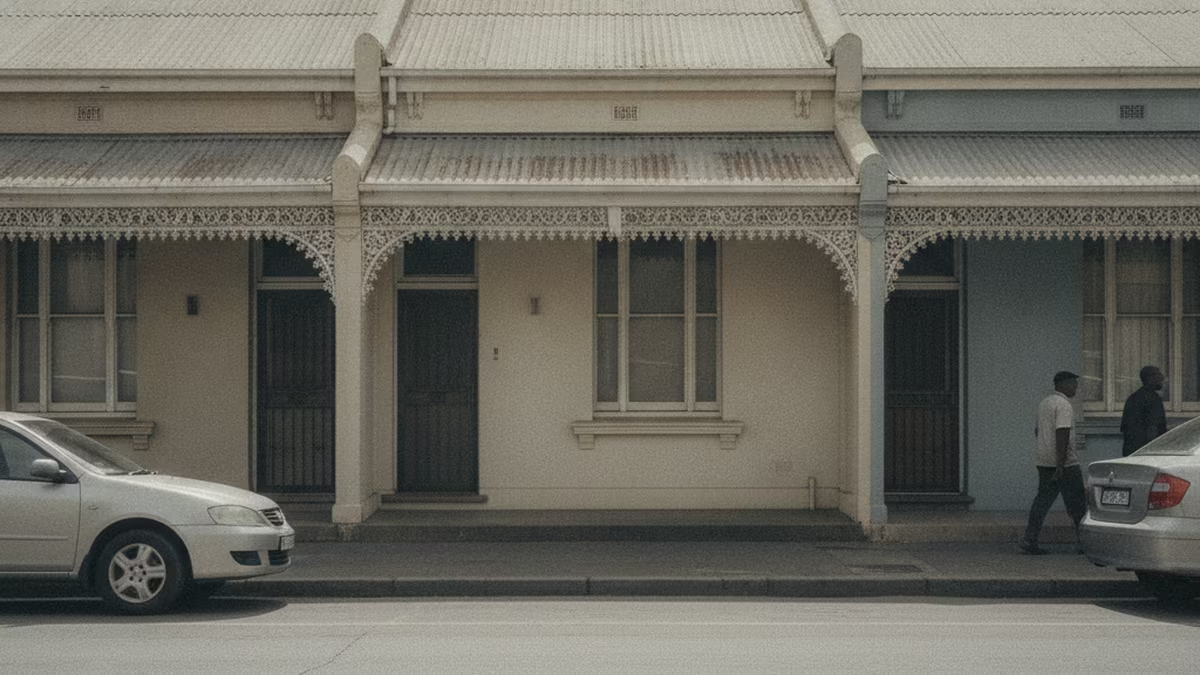
Significance in heritage terms covers more than architectural merit, which is why buildings owners consider unremarkable are sometimes protected. A structure can carry significance because of what happened in it, who lived or worked there, how it represents a way of building that has disappeared, or the part it plays in a street where the group matters more than any single building. Cape Town has a great deal of the last category: individually ordinary buildings whose value is the intact row they sit in. An assessment of a single property therefore considers its context, not just its walls.
Frequently asked questions
Who approves demolition of a heritage building in Cape Town?
Heritage Western Cape is the consenting authority in the Western Cape under the National Heritage Resources Act 25 of 1999. The South African Heritage Resources Agency handles nationally significant declared sites. Municipal planning approval applies in addition where the property sits in a heritage protection overlay zone.
Can a heritage building be demolished at all?
Yes, sometimes, and the outcome is not binary. Heritage Western Cape grants some permits unconditionally, grants others subject to recording or salvage conditions, grants others for partial demolition with facade retention, and refuses others outright. Planning a programme around only approval or refusal is where heritage demolitions most often go wrong.
What is a heritage impact assessment?
A heritage impact assessment is a report prepared by a heritage practitioner setting out the significance of the structure and the effect of the proposed demolition on it. It is normally required for graded resources and for structures in conservation areas, and it adds materially to both cost and programme.
What is facade retention?
Facade retention keeps the street elevation standing while the structure behind it is demolished. A free-standing masonry facade has almost no lateral stability, so an engineer-designed temporary steel support frame is installed before anything behind it is removed and stays until the new structure ties in. It costs more than full demolition.
Does a heritage permit mean I have to save materials?
Yes, where salvage conditions are attached. Specified elements are recovered, retained and documented rather than disposed of. Oregon pine joinery and flooring, cast-iron railings, pressed-metal ceilings, sash windows and original doors are the elements most commonly specified in Cape Town permits.