Types of Demolition: Scope, Method and Material
Demolition classifies three ways. Scope describes how much of the structure goes. Method describes how it comes down. Material describes what it is made of. A single job carries all three labels at once: a full demolition, carried out mechanically, on a masonry structure.
Free site visit and written quote anywhere in greater Cape Town.
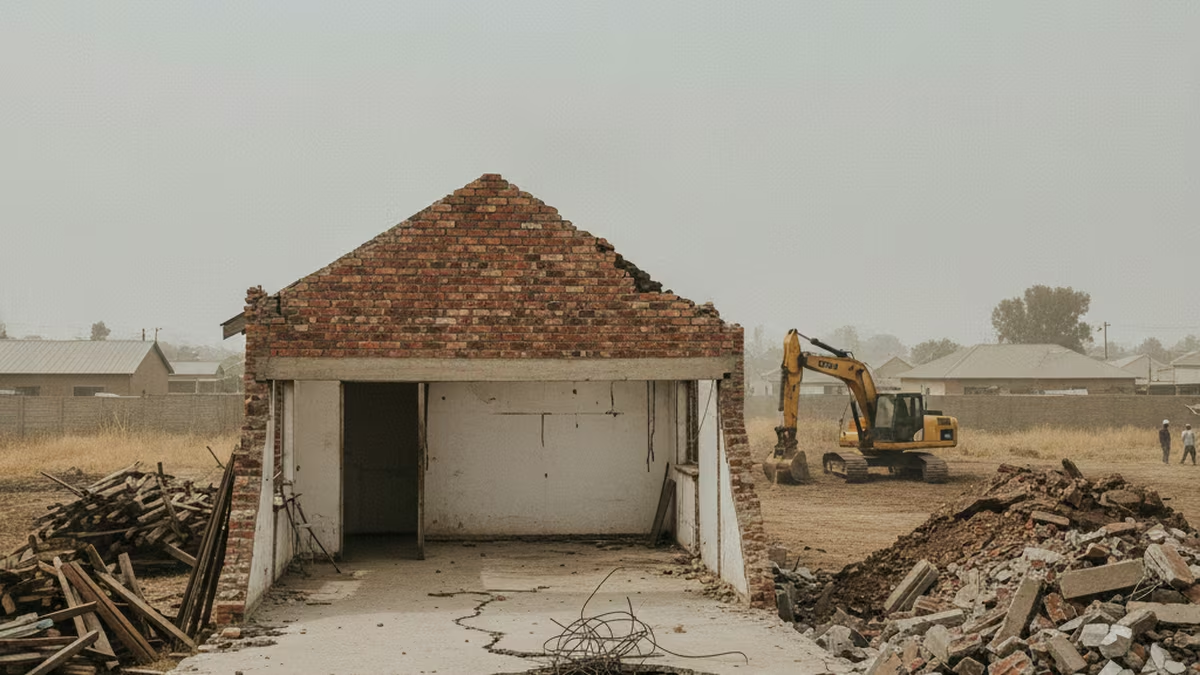
Types by scope
Scope is the first decision on any demolition, because it sets the permit route and the programme.
| Type | What goes | Structure stays in use |
|---|---|---|
| Total demolition | The entire structure above ground | No |
| Demolition to footings | The structure plus slab, foundations and footings | No |
| Partial demolition | A defined portion, such as a wing or an upper storey | Partly |
| Selective demolition | Specific elements: a wall, a chimney, a staircase | Yes |
| Interior strip-out | Non-structural interior only; the shell stays | Yes |
| Deconstruction | Dismantled in reverse build order to recover materials | No |
Demolition to footings
Demolition to footings takes the structure, the floor slab, the foundations and the footings out of the ground. Standard demolition stops at slab level and leaves the foundations in place. The distinction matters for a rebuild, because new foundations cannot be set on old footings of unknown condition. House demolition covers the strip depth in detail.
Types by method
Method follows from structure height, site access and what surrounds the building.
- Mechanical demolition — a tracked excavator with a breaker, pulveriser or shear. The default for detached structures with machine access.
- Manual demolition — hand tools, top-down, off scaffold. Used for chimneys, party walls and any element where a machine cannot control the drop.
- High-reach demolition — a long-boom excavator taking a structure down from the top. Used where height prevents a standard machine reaching safely.
- Controlled demolition — a pre-planned collapse sequence with defined exclusion zones, engineered so the structure falls within its own footprint.
- Deconstruction — reverse-order dismantling to recover brick, timber, sheeting and steel. Slower per square metre, offset by salvage value.
Types by material
Material determines the tool, the disposal route and the salvage value.
| Material | Primary tool | Salvage | Detail |
|---|---|---|---|
| Masonry — brick and block | Breaker, pulveriser | Face brick recoverable by hand | House demolition |
| Concrete — reinforced | Breaker plus rebar shear | Crushed for fill; steel to scrap | Concrete demolition |
| Structural steel | Oxy-cutting, shear | High — credited against the quote | Steel dismantling |
| Timber | Saw, hand tools | Oregon pine carries real value | Timber demolition |
| Precast concrete panel | Lifted, not broken | Panels reusable when undamaged | Vibracrete removal |
| Thatch | Hand strip | None; bulky low-density disposal | Roof removal |
| Sheet roofing — IBR, corrugated iron | Unscrewed and lifted | Sheeting resold when sound | Roof removal |
Types by structure
Every structure below is demolished as its own scope of work, priced separately.
- Houses, cottages and farm dwellings — house demolition
- Shops, offices, warehouses, factories, silos and tanks — commercial and industrial demolition
- Garages, sheds, wendy houses, carports and shade ports — outbuilding demolition
- Boundary walls, vibracrete, precast and palisade — wall removal
- Swimming pools — pool demolition
- Slabs, driveways, paving and retaining walls — concrete demolition
- Roofs of every covering — roof removal
- Whole plots ahead of a new build — site clearing
Frequently asked questions
What is the difference between demolition and deconstruction?
Demolition breaks a structure down by force and disposes of the material. Deconstruction dismantles it in reverse build order to recover brick, timber, sheeting and steel for reuse. Deconstruction runs slower per square metre and costs more in labour, offset against the salvage recovered. See reclaimed building materials.
What is selective demolition?
Selective demolition is the controlled removal of specific structural elements while the remainder of the building stays standing and in use. Typical scopes are a single load-bearing wall, a chimney, a staircase or one storey of a multi-storey structure. Temporary support goes in before any load-bearing element is cut. See partial demolition.
What does demolition to footings mean?
Demolition to footings removes the structure, the floor slab, the foundations and the footings from the ground, leaving clean soil. Standard demolition stops at slab level. A rebuild normally requires the footings out, because new foundations cannot be set on old footings of unknown condition.
What is a soft strip?
A soft strip removes all non-structural interior material from a building before the structure itself is touched. Fittings, linings, ceilings, partitions, flooring and services come out, and the shell stays standing. Soft strip precedes most commercial demolitions and is the whole scope of a fit-out removal. See interior strip-out.
Which demolition method is cheapest?
Mechanical demolition costs the least per square metre, because a single machine and operator take down more structure per hour than any hand method. Hand demolition costs the most, and applies where a machine cannot control the drop safely. Site access is the factor that most often forces the more expensive method.